
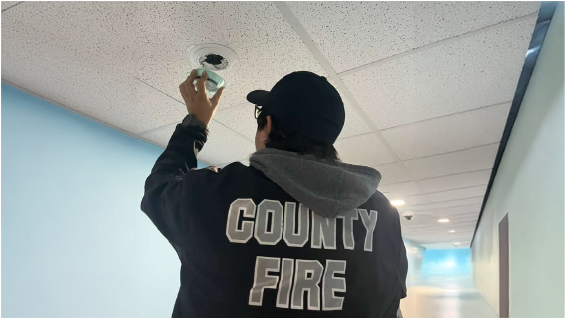
What is an Outdated Smoke Detector?
An outdated smoke detector is any life safety device that has exceeded its manufacturer-specified lifespan—typically 10 years—or has suffered sensor degradation that prevents it from accurately detecting smoke particles. Over time, dust, spiders, and chemical breakdown of the sensors (ionization or photoelectric) render the device unreliable, increasing the risk of failure during a fire event.
The Hidden Risks of Aging Life Safety Systems
Most property owners assume that as long as the "test" button makes a sound, the device is functional. However, the National Fire Protection Association (NFPA) reports that the sensors inside these units have a finite lifespan. An aging detector might still have enough power to sound a buzzer, but it may no longer have the sensitivity required to "see" or "smell" smoke in time to provide a life-saving warning.
Expert Insight: In our experience with professional fire safety audits, we frequently find units that are 15 or 20 years old. While the owners feel safe, these devices are essentially "blind" to the chemical signatures of a modern fire. Learn how County Fire professionals approach this in real inspections to ensure your building remains compliant.
5 Definitive Signs Your Smoke Detector is Outdated
- The Manufacture Date Has Expired
Flip your detector over. On the back, you will find a "Date of Manufacture" (DOM) stamp. If that date is more than 10 years ago, the unit is legally and functionally obsolete. If there is no date at all, it was likely manufactured before the mid-1990s and should be replaced immediately. - Discoloration and "Yellowing"
Modern smoke detectors are made of white flame-retardant plastic. Over time, the chemicals in the plastic react with oxygen and UV light, turning the unit a dingy yellow. This isn't just an aesthetic issue; it is a visual indicator that the internal components have been exposed to a decade or more of environmental stressors. - Frequent False Alarms or "Ghosting"
Does your alarm go off when you aren't cooking? As sensors age, they become prone to "nuisance alarms." In ionization detectors, the radioactive source (Americium-241) decays; in photoelectric units, the light chamber becomes clogged with microscopic debris. If your alarm is "crying wolf," it’s telling you its internal logic is failing. - The "Chirp" That Won't Quit
We’ve all experienced the low-battery chirp. But if you’ve replaced the battery and the unit continues to beep every 30 to 60 seconds, the device is likely signaling an "End of Life" (EOL) error. Most modern units have a programmed expiration signal. - Failure to Respond During a Test
The test button checks the circuitry and the siren, but it doesn't always check the sensor's ability to detect smoke. However, if the button itself is sluggish or fails to trigger the alarm immediately, the motherboard is compromised.
Comparison: Ionization vs. Photoelectric Alarms
When replacing outdated units, it is vital to understand the technology you are installing.
|
Feature |
Ionization Detectors |
Photoelectric Detectors |
|
Best For |
Fast-flaming fires (paper, grease) |
Slow, smoldering fires (upholstery, wiring) |
|
Technology |
Radioactive current |
Light scattering sensor |
|
Lifespan |
10 Years |
10 Years |
|
Common Failure |
High false alarms from cooking |
Dust buildup in the light chamber |
Not sure if your system meets current code? Many modern jurisdictions now require "Dual-Sensor" units or specific placements that DIY installations often miss. Get a quick inspection review to avoid last-minute violations before your next building certification.
Why Professional Inspection Trumps DIY Maintenance
For residential homes, a DIY battery swap is standard. However, for commercial buildings, HOAs, or multi-family complexes, the stakes are significantly higher.
Compliance and Liability
If a fire occurs and your detectors are found to be outdated, insurance providers may deny claims based on "negligence in maintenance." Professional fire safety firms provide a "paper trail" of compliance that protects property owners from litigation.
Interconnectivity Testing
Modern fire codes (like NFPA 72) often require detectors to be interconnected. If one triggered, they all sound. Testing these complex sequences requires specialized equipment that can simulate smoke without damaging the sensors.
System Integration
Are your smoke detectors linked to a central monitoring station or a sprinkler system? An outdated standalone unit is one thing; an outdated integrated system is a catastrophic failure waiting to happen.
Compare your building’s current setup with what certified inspectors look for. Don't wait for a fire marshal to hand you a fine. Schedule a quick system check while issues are still easy to fix.
Cost of Replacing Outdated Smoke Detectors
While a single battery-operated unit may cost $20–$50, the cost of a professional commercial upgrade varies based on:
- System Type: Hardwired vs. Wireless.
- Quantity: The number of zones in the building.
- Monitoring: Integration with 24/7 dispatch services.
Investing in a high-quality, professionally installed system usually pays for itself through reduced insurance premiums and the total avoidance of fire code fines.
FAQ: Common Questions About Smoke Detector Lifespan
Can I just clean my old smoke detector instead of replacing it?
No. While vacuuming dust out of a detector can reduce false alarms, it cannot "reset" the chemical decay of the sensors. After 10 years, the internal components are no longer reliable regardless of how clean the exterior looks.
Does a hardwired smoke detector last longer than a battery-operated one?
No. All smoke detectors, regardless of their power source (hardwired or 10-year sealed battery), rely on the same sensor technology. The 10-year replacement rule applies to every unit in your building.
What should I do if my smoke detector is chirping but the battery is new?
This is a classic "End of Life" signal. If the unit is over 7-8 years old, the internal processor has likely detected a sensor malfunction. It is time to replace the unit entirely.
Is it better to hire a professional for smoke detector installation?
Yes, especially for hardwired systems. A professional ensures that units are placed in "dead air" spaces, are correctly interconnected, and meet the specific local fire codes for your county or municipality.
Why does my smoke alarm go off when I shower?
Steam can interfere with photoelectric sensors. If this is happening frequently, the unit may be placed too close to a bathroom, or the sensor has become overly sensitive due to age. A professional can help with strategic relocation.
Key Takeaways for Property Managers
Audit Annually: Check the manufacture dates of at least 20% of your units every year.
Standardize: When replacing units, use the same brand and model to ensure seamless interconnection.
Document Everything: Keep a log of replacement dates to present to fire marshals and insurance adjusters.
Upgrade Technology: If you are replacing units, move to photoelectric or dual-sensor technology for better coverage.
Protect Your Assets and Occupants with County Fire
An outdated smoke detector is more than a nuisance; it’s a liability. Whether you are managing a single-family home or a massive industrial complex, the 10-year rule is your most important safety benchmark. By staying proactive, you ensure that when the unthinkable happens, your safety systems will perform exactly as designed.
Don't leave your safety to chance. Book a certified inspection with County Fire today to ensure your fire systems are fully compliant before your next deadline. Our expert technicians will help you avoid unexpected violations and, more importantly, keep your property safe.