Certificate of Fitness vs Certificate of Occupancy: What NYC Building Owners Need to Know
The two names sound like variations on the same document. They are not related, they come from different agencies, and they certify different kinds of thing entirely.
Confusing them is common enough that it shows up in tenant negotiations, insurance questionnaires, and the occasional panicked call before an inspection. The distinction is simple once stated.
A Certificate of Occupancy Describes the Building
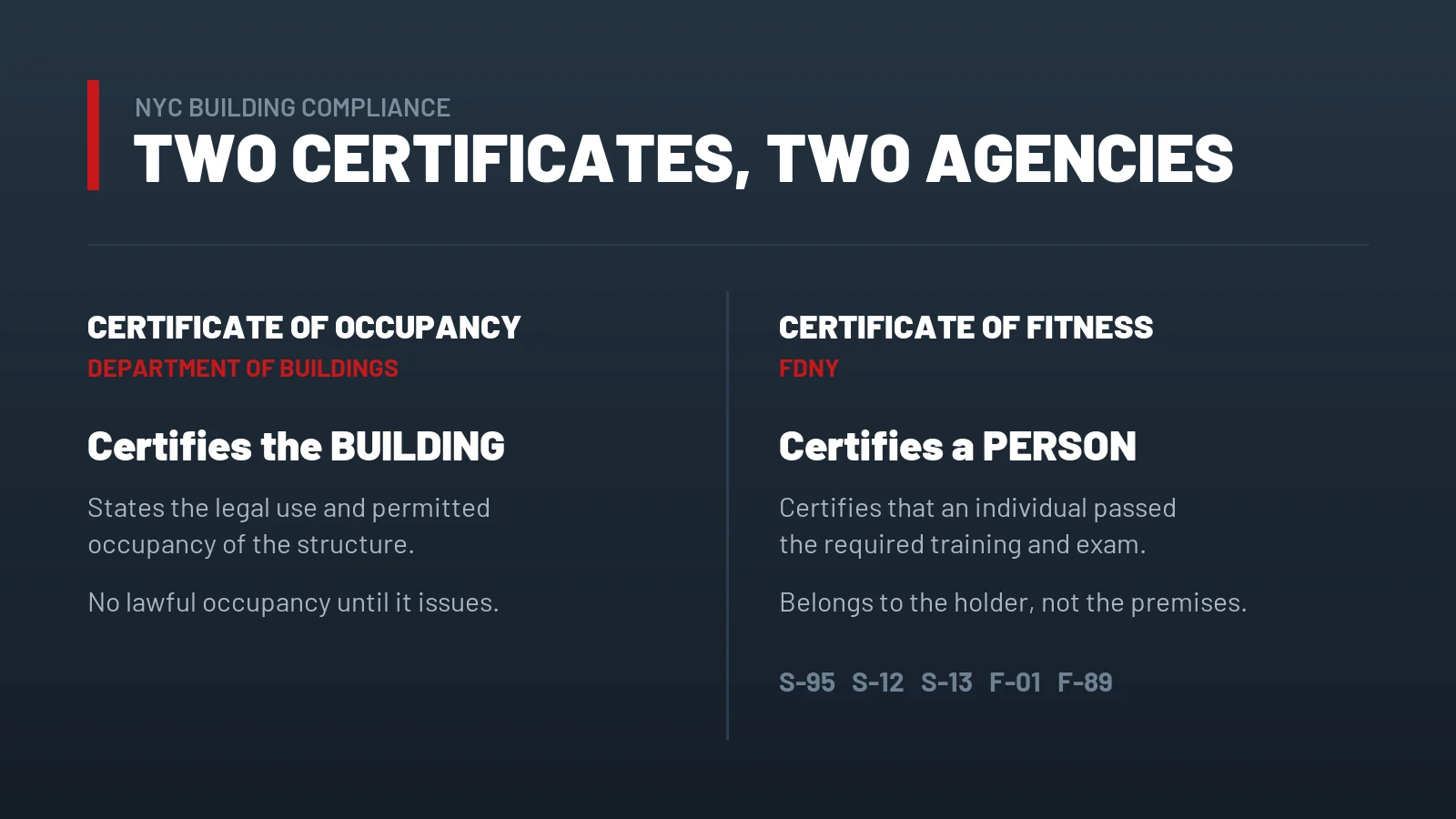
A Certificate of Occupancy is issued by the Department of Buildings, and it states the legal use and the permitted occupancy of a structure. It is the document that says what a building is allowed to be.
Issuing one means the DOB is satisfied that completed work complies with applicable law, that the paperwork is finished and fees paid, that relevant violations have been resolved, and that the necessary approvals from other city agencies are in hand. Until the department issues either a Certificate of Occupancy or a Temporary Certificate of Occupancy, a building may not legally be occupied.
Two practical consequences follow. A change of use generally requires an amended certificate — converting a floor from storage to assembly is not merely a fit-out. And because outstanding violations sit between you and issuance, a fire safety finding left open can hold up a certificate that has nothing to do with fire protection on its face.
There is also a temporary form. A Temporary Certificate of Occupancy permits lawful occupancy for a limited period while remaining items are resolved, which is why buildings in the final stage of a project can be occupied at all. It expires, and letting it lapse with work still outstanding is its own problem.
A Certificate of Fitness Describes a Person
A Certificate of Fitness is issued by the FDNY, and it certifies an individual. It says that a named person has completed the required training and passed the required examination to perform a specific fire-safety duty in the city.
It attaches to the holder, not to the premises. It does not travel with the building when it is sold, and it does not transfer between staff. When the person holding it leaves, the building's coverage leaves with them — which is the single most common way an otherwise well-run property discovers it has a gap.
There are many categories, each tied to a particular responsibility rather than to a general competence. The ones a commercial building most often needs sit close to the systems we work on:
- S-95 — supervision of fire alarm systems and other related systems
- S-12 — supervision of sprinkler systems, citywide
- S-13 — supervision of standpipe systems, citywide
- S-11 — supervision of residential sprinkler systems
- F-01 — citywide fire guard for impairment
- F-89 — fire life safety director
Which ones apply depends on the systems installed, the occupancy, and the building's size and staffing. The list is long and the boundaries are specific, so the question to ask is not whether someone on staff holds a Certificate of Fitness but whether the right categories are covered.
Where Fire Protection Touches Both
The systems themselves are the connection.
For the Certificate of Occupancy, fire protection is part of what has to be complete and approved before a certificate issues or is amended. Detection, notification, and suppression appropriate to the intended use are not an add-on to the occupancy question — they are part of it.
For Certificates of Fitness, the systems determine which categories your building needs covered. A building with a sprinkler system and a fire alarm has different personnel requirements than one with neither, and adding a system through a renovation can create a certification requirement nobody accounted for in the project budget.
The overlap catches owners during change of use. A conversion that requires an amended Certificate of Occupancy frequently also changes the fire protection required, which in turn changes which Certificates of Fitness the building needs on site. Our FDNY compliance resources cover how those requirements interact, and fire alarm design and installation covers the system side of a change of use.
Where Owners Get Caught Out
Assuming the certificate covers the building. A Certificate of Fitness belongs to a person. Staff turnover is a compliance event, not just an HR one.
Assuming one category covers everything. The categories are narrow by design. Holding one does not imply authority over an adjacent system.
Discovering the requirement during a renovation. Adding or substantially altering a system can create both an amended occupancy certificate and a new personnel requirement. Both are cheaper to plan for than to resolve retroactively.
Treating an old Certificate of Occupancy as descriptive. Buildings drift from their certificates over decades of tenancy. The document says what the building is permitted to be, which is not always what it is currently being used as.
Frequently Asked Questions (FAQ)
Does my building need a Certificate of Fitness?
Buildings do not hold Certificates of Fitness — people do. The question is whether the individuals responsible for supervising your fire protection systems hold the categories those systems require, such as S-95 for fire alarm supervision or S-12 for sprinkler systems. Which categories apply depends on the systems installed, the occupancy, and how the building is staffed.
Can a Certificate of Fitness transfer to a new employee?
No. The certification belongs to the individual who earned it and does not transfer between people or convey with a building at sale. When a certified staff member leaves, the responsibility they covered needs another certificate holder, and that gap opens the day they do.
Can an open fire safety violation affect my Certificate of Occupancy?
It can. Issuing a certificate requires that relevant violations be resolved and that approvals from other city agencies be in place, so an unresolved finding can sit between a completed project and the certificate that lets the space be occupied. That is one reason clearing findings promptly matters beyond the penalty attached to them.
County Fire Inc. has worked alongside NYC owners and managing agents on these requirements since 2015, across alarm, sprinkler, and extinguisher systems in all five boroughs. If a change of use or a renovation has raised questions about what your building now needs, call (888) 470-3473 or start with our FDNY compliance overview.