NYC Local Law 26 Fire Safety Compliance: A Guide for Commercial Buildings
Local Law 26 is the largest fire protection obligation attached to most older NYC office buildings, and its deadline passed in July 2019. Buildings that missed it are not in a grace period — they are accruing penalties, and the meter started running in 2022.
If you took over a building recently, or inherited a file that says "LL26 in progress," this is what the law actually requires and where the exposure sits.
What Local Law 26 Requires
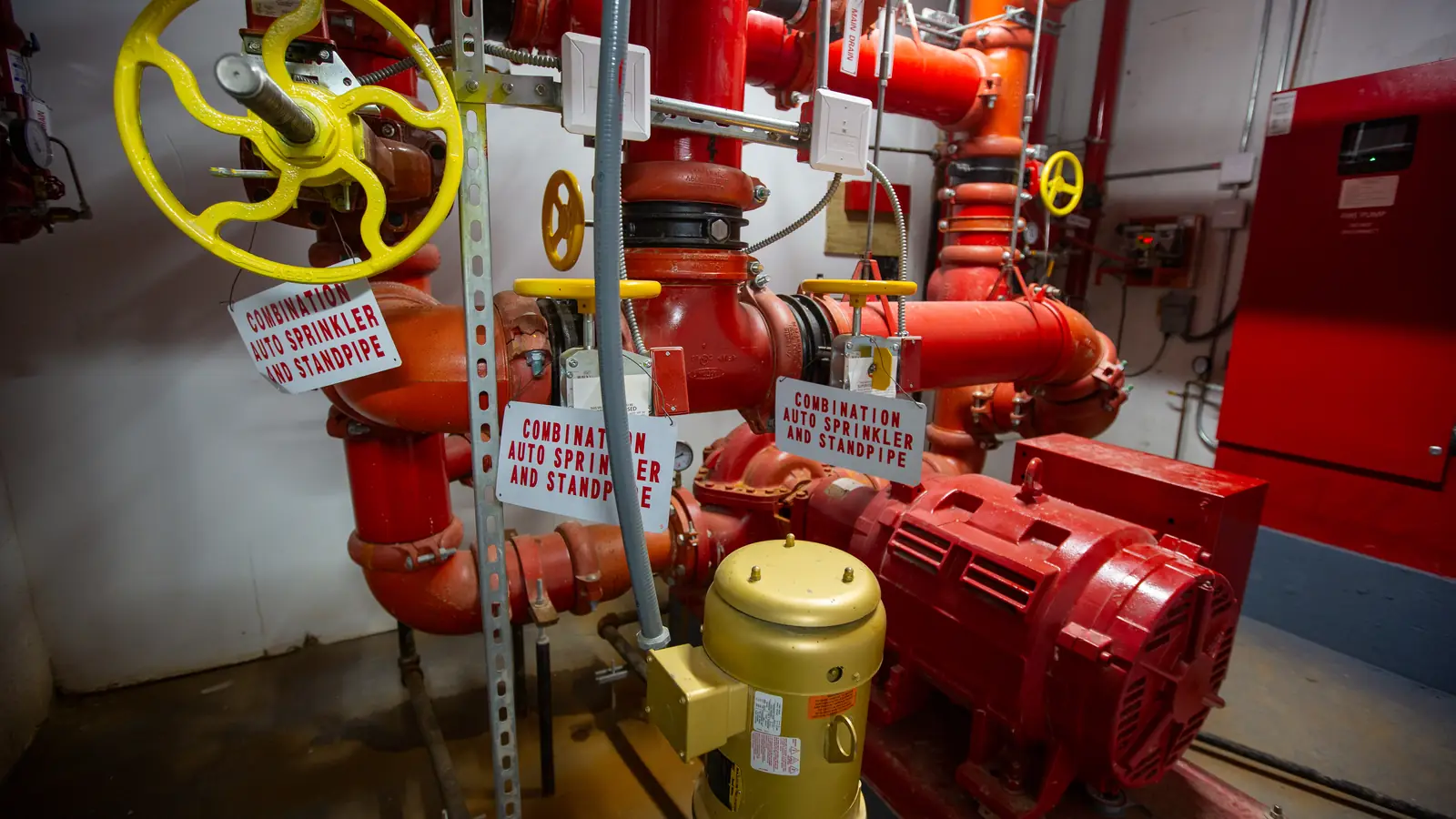
Local Law 26 of 2004 came out of the World Trade Center Building Code Task Force, the review the City ran after September 11 to close gaps that evacuation studies had exposed. It has two halves, and buildings routinely comply with one while forgetting the other.
The first half is sprinklerization. Existing office buildings 100 feet or taller were required to install a full system of automatic sprinklers throughout, with installation complete and certified by July 1, 2019. This was a retrofit mandate applied to buildings that were legal when built, which is why so many owners treated it as optional for a decade and then ran out of runway.
The second half is exit path markings. High-rise office buildings — those with occupied floors more than 75 feet above the lowest level of fire department vehicle access — were required to install photoluminescent markings in the exit stairs, conforming to reference standard RS 6-1. That means step edge markings on every tread, landing demarcation lines, handrail markings, door and door frame markings, and floor identification signs at each landing. The material has to be approved, washable, non-toxic, and self-extinguishing.
The marking requirement had a much earlier deadline than the sprinkler mandate, and because it involves no mechanical work, it is the half most often assumed to have been handled by someone.
Who It Applies To
The law targets office occupancies, not residential ones. A pre-war apartment building over 100 feet is not covered by the LL26 sprinkler mandate, and owners of mixed portfolios sometimes generalize in the wrong direction — either assuming everything tall is covered, or assuming that because their residential stock is exempt, their one office property is too.
Two categories cause most of the confusion. Mixed-use buildings with substantial office floor area need the occupancy classification confirmed rather than assumed, because the classification on file governs and it is not always what the building is actually used for today. And buildings near the threshold need the height measured the way the code measures it, not the way a marketing brochure describes it.
Waivers exist but are narrow. Landmarked properties, with Landmarks Preservation Commission confirmation, and buildings with structural conditions that genuinely prevent installation may seek relief, subject to the commissioner's approval and to alternative fire safety measures being put in place. This is a determination, not a filing you make and forget.
The Deadline Passed. The Obligation Did Not.
After July 1, 2019, the Department of Buildings stopped accepting hardship and extension letters. There is no longer a version of this where a building explains why it needs more time.
Clearing the obligation now takes three things, all of them:
Installation at 100 percent. Full coverage throughout the building. A temporary loop serving a vacant floor does not satisfy the requirement, and neither does a floor-by-floor buildout that stopped when a tenant left.
Every open sprinkler application signed off. Permits pulled during the retrofit have to be closed out. Buildings that did the physical work and left applications open are non-compliant on paper while being fully sprinklered in reality.
The final sprinkler report filed and approved. Prepared by a registered architect or professional engineer, submitted to DOB, and stamped approved. Until that document exists, the building is treated as non-compliant regardless of what is hanging from the ceiling.
What Non-Compliance Costs
DOB's sprinkler report rule attaches two separate civil penalties, and they run concurrently. Failure to file an acceptable report carries $5,000 per year, beginning January 1, 2022 and ending on the date an acceptable report is filed. A late filing carries an additional $1,000 per month, beginning February 1, 2022 and ending on the same date.
Both accrue from those fixed start dates rather than from when anyone notices, so a building that has been quietly non-compliant since 2019 is not looking at a fresh penalty — it is looking at four years of accumulation. The associated DOB violation is dismissed when the approved report is on file and proof of penalty payment has been received. Filing alone does not clear it.
The financial exposure that shows up first is usually not the penalty. It is a lender's due diligence, an insurance renewal, or a prospective tenant's counsel finding an open LL26 violation during a lease negotiation. Those conversations happen on someone else's timeline.
What Getting Compliant Involves
Start with a survey of what is actually installed. Buildings that worked through this in stages often have better coverage than their paperwork suggests, and the gap is a filing problem rather than a construction one. Buildings that never started need design, filing, and phased installation around occupied floors, which is a project measured in months.
From there the path is design and permit filing, installation, close-out of every open application, and the final report. Sprinkler design and retrofit work in occupied office buildings is its own discipline — see fire sprinkler design and installation for how that work is scoped. Once the system is in, it enters the ordinary sprinkler inspection and testing cycle under NFPA 25, which is a separate and continuing obligation.
The exit path markings, if they were never installed or have degraded, are a comparatively short project and worth handling in the same pass.
Frequently Asked Questions (FAQ)
Does Local Law 26 apply to residential buildings?
No. The Local Law 26 sprinkler mandate applies to office buildings 100 feet or taller, not to residential occupancies. Mixed-use buildings with significant office space should have their occupancy classification confirmed against what is on file with the City rather than assumed, because the classification governs whether the mandate attaches.
We installed sprinklers years ago but never filed the report. Are we compliant?
No. Installation and certification are separate obligations, and the penalties are written against the failure to file rather than the failure to install. A fully sprinklered building with no approved final report on file is non-compliant and accruing civil penalties, which is one of the more frustrating ways to owe money to the City.
Can we still request an extension or hardship relief?
Not for the deadline itself. The Department stopped accepting hardship and extension letters after July 1, 2019. Narrow relief remains available for landmarked buildings and for structural conditions that prevent installation, but that is a determination requiring commissioner approval and alternative fire safety measures, not a deferral.
How is the 100-foot height threshold measured?
By the code's method rather than by floor count or listed building height, which is why buildings in the 95 to 105 foot range should be confirmed by a design professional rather than estimated. Note also that the exit path marking provision uses a different and lower trigger — occupied floors more than 75 feet above fire department vehicle access — so a building can fall below the sprinkler threshold and still be covered by the marking requirement.
County Fire Inc. has been sprinklering and certifying NYC commercial buildings since 2015, including LL26 retrofits in occupied office space and filings on projects that stalled years ago. LL26 work is carried out under our broader fire protection services. To get a straight read on where your building stands, call (888) 470-3473 or start with our FDNY compliance overview.