How Often Do Fire Sprinkler Heads Need to Be Replaced: NFPA 25 Requirements
Sprinkler heads are sealed devices that sit untouched for decades, and most property managers have never been given a straight answer about when they expire. The answer is not a single number, and the most common version of it — that heads last 50 years — is close enough to the standard to sound right while being wrong for a large share of the heads in NYC commercial buildings.
NFPA 25, the standard for inspection, testing and maintenance of water-based fire protection systems, sets different intervals for different sprinkler types. It also gives you a choice at each interval: replace the heads, or test a representative sample and keep the rest in service. Knowing which interval applies to your building, and which of those two options makes sense, is the difference between a planned expense and a surprise one.
The Date Stamp on the Deflector Tells You Where You Stand
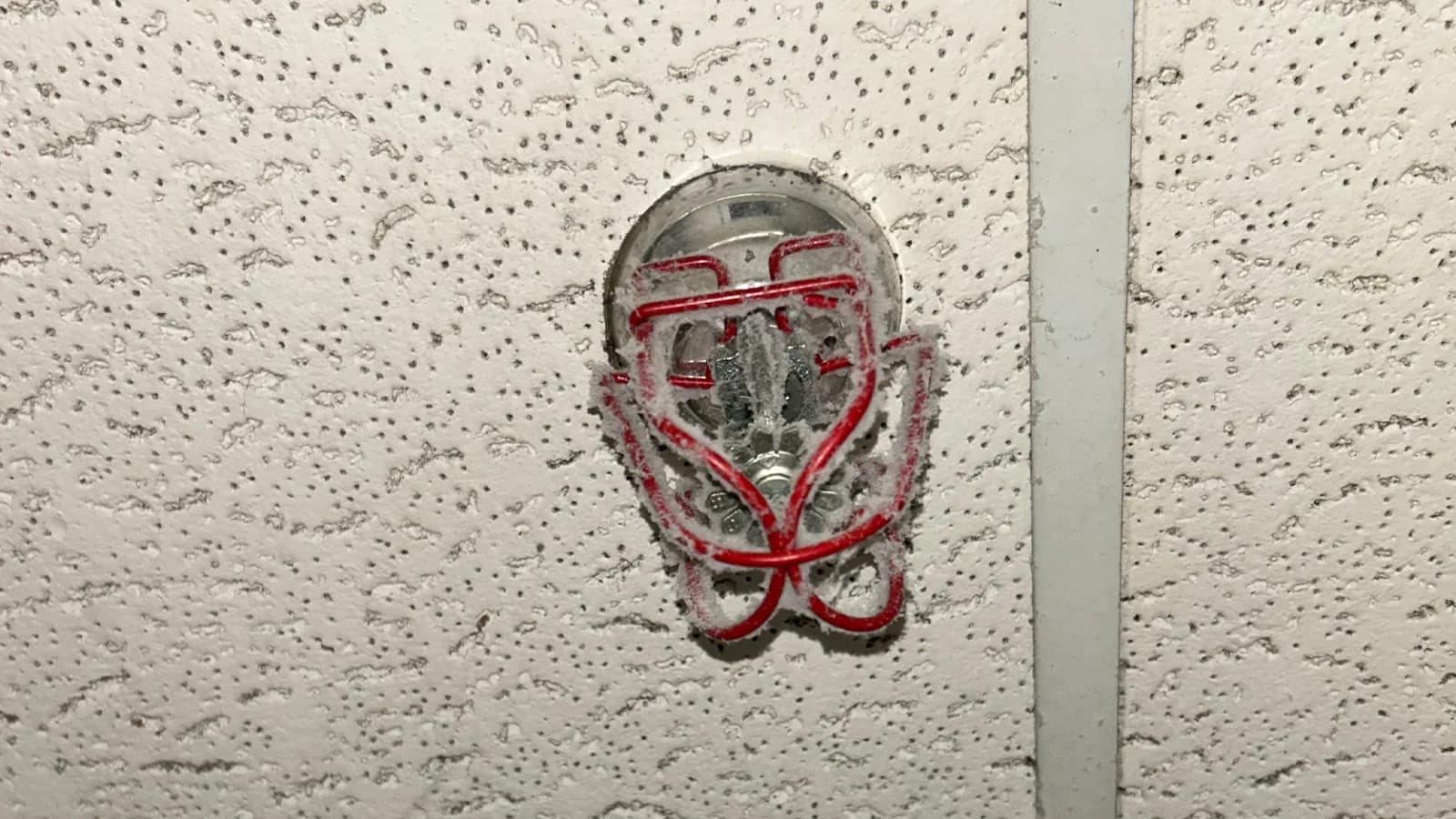
Every sprinkler head carries its year of manufacture stamped on the deflector, the small flat plate at the bottom that spreads the water. That year, not the year the building opened or the year of the last renovation, starts the clock on every interval below.
This matters because buildings rarely have one population of heads. A 1970s warehouse that was partly converted to office space in 2008 may have original standard heads over the storage area and fast-response heads in the finished space, with two entirely different replacement dates and two different intervals. Tenant build-outs, ceiling changes, and past repairs all leave heads of mixed age behind.
Before you can plan anything, someone has to record what is actually installed: type, temperature rating, manufacturer, model, and date, area by area. On most buildings that work happens during fire sprinkler inspection and testing, because the technician is already on a lift looking at the heads. If your inspection reports do not contain that inventory, ask for it — it is the document every decision in this article depends on.
What NYC's Adopted NFPA 25 Requirements Mean for Sprinkler Heads
NFPA 25 Chapter 5 covers sprinkler systems, and its requirements for the heads themselves fall into two groups: an annual look from the floor, and a test-or-replace milestone that depends on the type of head. The intervals below are the ones that apply to a building in the five boroughs through the NYC Fire Code, which adopts NFPA 25 as its standard for inspection, testing and maintenance of water-based systems. NFPA revises the standard on its own cycle and the city adopts editions on its own, so confirm the governing edition with your contractor before planning a capital cycle around a date rather than assuming the newest national edition applies here.
The annual inspection is visual and done from floor level. The technician is confirming that each head is free of corrosion, paint, physical damage and loading — the film of dust, grease or lint that builds up on a head and can insulate its heat-sensitive element — and that it is installed in the correct orientation with its escutcheon in place. A head carrying paint, corrosion, loading or physical damage is replaced rather than cleaned. An orientation or escutcheon problem is a condition to be corrected, which may or may not call for a new head.
The test-or-replace milestones are where the intervals differ:
- Standard-response sprinklers: at 50 years from manufacture, then every 10 years after that
- Fast-response sprinklers, which include quick-response, residential, ESFR and on-off heads: at 20 years, then every 10 years after that
- Dry sprinklers, the type used to protect unheated spaces from a heated supply: at 10 years, then every 10 years after that
- Extra-high-temperature (325°F and above) solder-type sprinklers exposed to sustained high ambient temperatures: every 5 years
- Sprinklers in harsh environments, meaning corrosive atmospheres or corrosive water supplies: every 5 years
Heads manufactured before 1920 are not eligible for sample testing and must be replaced outright.
Why Sample Testing Usually Beats Replacing Every Head
At each milestone you may either replace the affected heads or submit a representative sample to a recognized testing laboratory. The sample is the greater of four heads or one percent of the heads in that group, and the laboratory tests them for sensitivity and for the ability to operate at their rated temperature.
The arithmetic tends to favor testing. On a building with several hundred heads, a sample is a handful of devices plus the labor to remove and patch those locations, against wholesale replacement of every head in the area, with the ceiling work and tenant disruption that comes with it. If the sample passes, the remaining heads stay in service for another 10 years and the milestone resets.
If the sample fails, that result applies to the whole group: all heads of that manufacturer, model and type in the sampled area are replaced. That is the outcome you are buying information about, and it is worth knowing before a failed FDNY inspection or a leak makes the decision for you. Either way, the replacement or sprinkler maintenance and repair work that follows should be scheduled rather than improvised.
The Conditions That Force Replacement Before the Interval
Age is only one of the reasons a head comes out. Several conditions require replacement regardless of how many years are left on the clock, and all of them are visible during a routine inspection.
Painted heads are the most common. A painter who sprays a ceiling without masking the heads has changed how quickly the element responds to heat, and every affected head must be replaced. Factory-applied finishes are the only coatings permitted. Corrosion is the next most common, particularly in kitchens, parking garages, pool areas and any space with a corrosive atmosphere, and it is also the trigger for the 5-year harsh-environment interval.
Mechanical damage covers a bent or missing deflector, a head struck by a forklift or a ladder, and anything hung from a head or its piping. Loading — heavy dust, grease or lint on the element — requires replacement rather than cleaning, because cleaning a head can damage the element you are trying to preserve. Missing or improper escutcheons must be corrected, and sprinklers installed in the wrong orientation must be properly repositioned or replaced as necessary.
One requirement that gets confused with the head intervals is worth separating out: pressure gauges on the system are tested or replaced on their own 5-year cycle. That is a different device and a different rule, and satisfying one does nothing for the other.
Spare Heads and the Cabinet an Inspector Will Open
NFPA 25 also requires a stock of spare sprinklers on site, in a cabinet kept where the ambient temperature will not exceed 100°F. The quantity scales with the system: at least 6 spares for systems with up to 300 heads, 12 for systems with 300 to 1,000 heads, and 24 for systems above 1,000 heads.
The cabinet must hold the right spares, not just the right number — matching type, orifice size and temperature rating for every variety installed in the building — along with a sprinkler wrench for each type and a list of what the cabinet contains. A cabinet stocked with the wrong temperature rating is a finding, and it also means nobody can put a replacement head in quickly after an activation.
This is a small item that tells an inspector a great deal. An accurate cabinet with a current list suggests someone knows what is installed overhead. An empty cabinet with a broken wrench suggests the opposite, and it tends to direct attention toward the rest of the fire sprinkler system.
Frequently Asked Questions (FAQ)
Do fire sprinkler heads expire?
Not on a shelf-life basis, but NFPA 25 sets a milestone at which each head must either be replaced or represented in a laboratory sample test. That milestone is 50 years for standard-response heads, 20 years for fast-response heads, 10 years for dry sprinklers, and 5 years for heads in corrosive conditions or for extra-high-temperature solder-type heads exposed to sustained high ambient temperatures. Passing a sample test extends the population by 10 years at a time.
How do I find out how old my sprinkler heads are?
The year of manufacture is stamped on the deflector of each head. A technician on a lift can read it during an annual inspection, and the result belongs in your inspection records as an inventory by area, since most buildings have heads of several different ages and types.
Can a sprinkler head be cleaned instead of replaced?
No. A head with paint, corrosion or heavy loading on it must be replaced, because cleaning risks damaging the heat-sensitive element and because the coating has already changed the head's response. Sprinkler heads also cannot be repaired, adjusted or altered in any way.
Does the FDNY enforce NFPA 25 sprinkler head requirements in NYC?
Yes. The NYC Fire Code adopts NFPA 25 as the standard for inspection, testing and maintenance of water-based fire protection systems, so the intervals and inspection conditions above are enforceable in the five boroughs. Records are part of it — an inspector can ask what is installed and when it was last tested, and not having the answer is its own problem.
County Fire has serviced commercial fire sprinkler systems across Manhattan, Brooklyn, Queens, the Bronx and Staten Island since 2015, and we inventory head type, temperature rating and date of manufacture as part of the work rather than as an extra. If you do not know how old the heads in your building are, or you have a milestone coming up and want to compare sample testing against replacement, call (888) 470-3473 or start with our fire sprinkler maintenance and repair service.