Fire Alarm Panel Brands Explained: Mircom, Notifier, Simplex, Honeywell, Edwards EST Compared
Most property managers inherit a fire alarm panel rather than choose one. The brand on the door then quietly determines who can service the building, how quickly parts arrive, and how many contractors can give you a competitive price.
Here is what separates the brands we work on most, the platform we specify more than any other, and the one question that matters more than any feature comparison.
Who Actually Makes These Panels
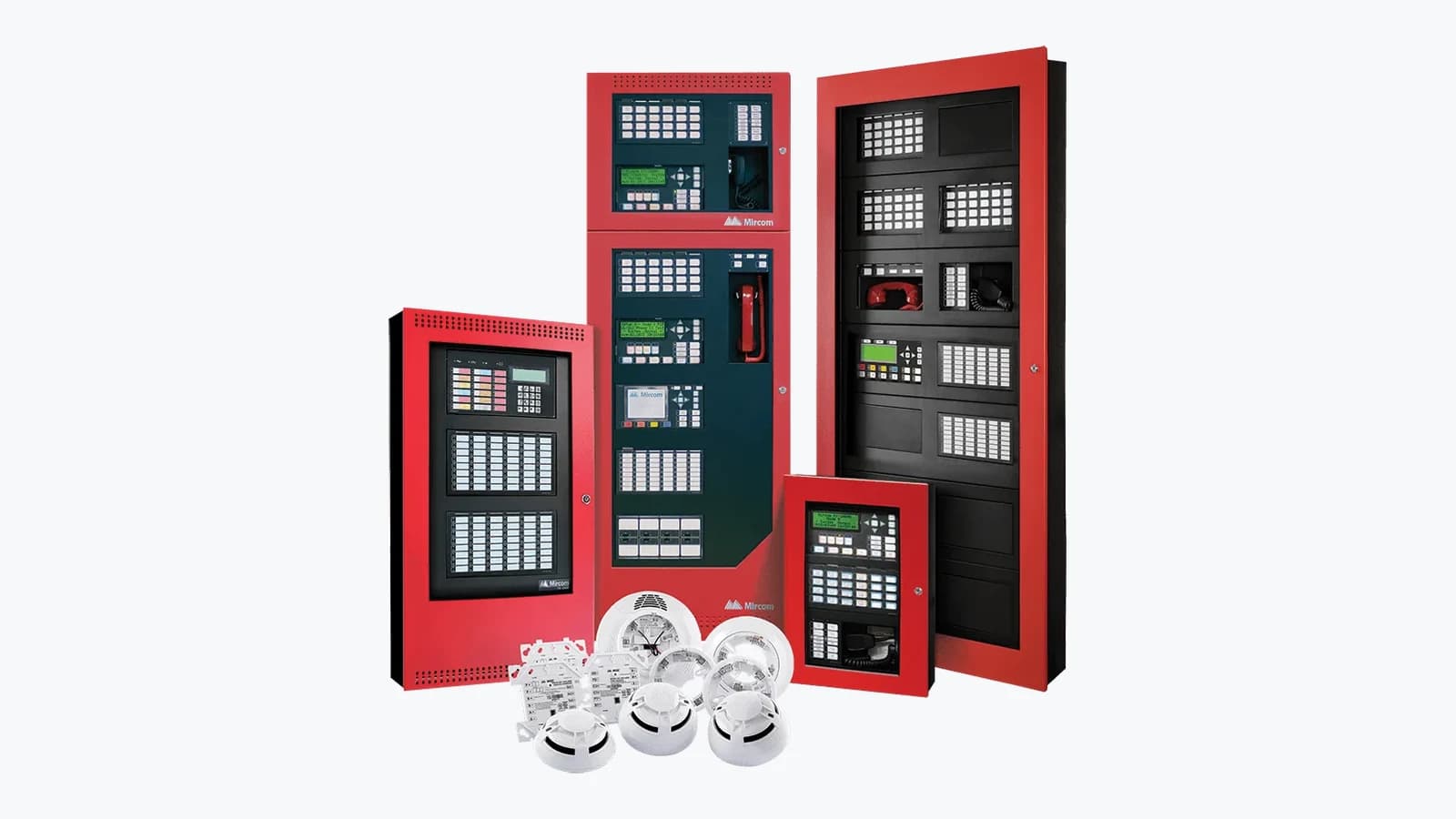
The first thing worth knowing is that the brand names in this market do not map one-to-one onto companies. Most of them belong to a handful of large conglomerates.
Honeywell owns Notifier, Silent Knight, and Gamewell-FCI, along with Fire-Lite and System Sensor. Silent Knight was acquired in 1999; Gamewell-FCI came out of a mid-2000s merger of two older names, Gamewell and Fire Control Instruments. They remain distinct product lines with separate parts and programming tools, but they share a parent.
Johnson Controls owns Simplex, acquired in 2001 and now sold through the Johnson Controls fire detection business.
Edwards EST has changed hands the most. General Electric acquired it in the mid-2000s, United Technologies took it in 2010 and it sat under Carrier, and when Carrier divested its fire business the line moved to Kidde Global Solutions. The technology did not change on any of those dates, but corporate churn is worth knowing about when you are asking how long a platform will be supported.
Mircom is the exception, and it is the reason we start there.
Mircom: The Platform We Specify Most
Mircom is the one genuinely independent manufacturer in this comparison. It was founded in Ontario in 1991, is still family-run from its headquarters in Vaughan, and has grown into the largest independent designer and manufacturer of life safety systems in North America. It has not been absorbed into a conglomerate, and that shapes how the product is supported.
The platform itself is serious equipment. The FleX-Net series is a networkable intelligent addressable system that handles detection, notification, voice evacuation, and emergency communications on one architecture, alongside the longer-running FX-2000 line. It integrates with building systems over standard protocols such as BACnet and Modbus, which matters in properties where the fire alarm has to coexist with building management, access control, and elevator status reporting rather than sit in isolation.
For NYC work, that combination lands well. A large share of the buildings we serve are high-rise residential and mixed-use, where the requirement is a networked addressable system with voice communication capability, at a cost that a co-op or condo board will actually approve. Mircom competes directly with the large engineered platforms on capability while typically coming in below them on installed cost.
The independence has a practical consequence too. Support and parts come from a manufacturer whose entire business is life safety, rather than from one division inside a conglomerate that also makes thermostats, chillers, or jet engine components. When a platform's roadmap depends on a corporate portfolio decision, that is a variable outside your control and outside ours.
We are not exclusive to it. If your building already runs Notifier or Simplex, the sensible answer is usually to stay in that ecosystem rather than rip out working infrastructure. But when a building is genuinely choosing, Mircom is where we start.
The Honeywell Lines: Notifier, Silent Knight, Gamewell-FCI
These three cover a wide span of building sizes, which is why they turn up so often across NYC.
Notifier is the engineered addressable line — the one specified for large commercial buildings, high-rises, campuses, and anything with a serious device count and networked panels. It is capable and well supported, and its parts move through engineered system distributors rather than general electrical supply.
Silent Knight sits at the smaller end: single-building commercial, mid-rise residential, and properties where the device count does not justify a large engineered platform. Its practical advantage is distribution. Parts and programming tools are more openly available, which means more contractors can competently work on it.
Gamewell-FCI has deep roots in municipal fire alarm and remains common in institutional buildings and older NYC properties. Buildings that have had a Gamewell system for decades often have good reason to stay in that ecosystem rather than rip out working infrastructure.
Simplex and Edwards EST
Simplex shows up in large institutional work — hospitals, universities, transit, and major commercial towers. The platform is strong and the tooling is mature. The tradeoff is distribution: Simplex parts and programming are tightly controlled, and that narrows the field of who can service the system. If your building runs Simplex, you should know that before you go looking for a second quote.
Edwards EST occupies similar territory. It is a high-end engineered platform with a long track record in voice evacuation and large networked systems. As with Simplex, the parts channel is more restricted than the Honeywell lines, and the ownership changes described above are worth factoring into a long-term support question.
None of this makes either brand a bad choice. Both are specified constantly in serious buildings for good reasons. It does mean the servicing question is a real part of the total cost, not a footnote.
The Question That Actually Matters
Buildings rarely fail an inspection because of the brand on the panel. They run into trouble because of what the brand implies about access.
Three things follow from the manufacturer's distribution model. Who can get parts — an open line means a board can be sourced quickly from multiple channels, while a controlled line may route through a single authorized path with its own lead time. Who has the programming software — an addressable panel is configured in software, and if a contractor cannot obtain and run the correct version for your platform, they cannot add a device, change a zone, or correct a mislabeled address. How many firms can bid the work — which is what actually sets your price over a ten-year horizon.
This is the practical reason we service Mircom, Notifier, Simplex, Honeywell, Edwards EST, Silent Knight, and Gamewell-FCI rather than working on one platform only. A contractor who works on one platform has an obvious interest in telling you your building needs that platform. Our fire alarm services are built around the system you already have, and a replacement should be justified by the system's condition rather than by the servicing company's parts inventory.
Choosing a Brand for a NYC Building
If you are specifying a new system, three things should drive the decision more than brand preference.
Building size and device count. A large engineered platform in a small building is money spent on capacity you will never use. A small platform in a building that will expand is a problem deferred.
What is already installed. Existing wiring, device compatibility, and the panels in adjacent buildings under the same ownership all matter. Staying within an ecosystem is often the cheaper and less disruptive path.
Servicing reality in your area. A platform that is well supported nationally but thinly supported locally will cost you on response times.
Whatever you choose, the FDNY process is the same. Fire alarm design documents must be filed with the department for approval before installation, the work has to be performed by appropriately licensed personnel, and the system has to pass acceptance testing before it is signed off. No brand shortens that path.
Frequently Asked Questions (FAQ)
Why does County Fire install Mircom more than other brands?
Because for the buildings we work in most — NYC high-rise residential and mixed-use — it hits the right combination of networked addressable capability, voice and emergency communication support, and installed cost. It is also the one independent manufacturer among the major platforms, so its support and parts come from a company that does life safety and nothing else. Where a building already runs another platform, we service that platform rather than pushing a change.
Is one fire alarm panel brand safer than another?
No. All of these are listed, code-compliant platforms, and a properly designed and maintained system from any of them will protect a building. The meaningful differences are in capacity, feature sets for large networked or voice evacuation systems, and how freely parts and programming tools are distributed.
Do I have to use the company that installed my system?
Not usually, though the brand affects how much choice you have. Openly distributed lines like Silent Knight can be serviced by many qualified contractors. More tightly controlled platforms such as Simplex and Edwards EST narrow the field, because a servicing firm needs both parts access and the correct programming software for your panel.
Can I replace just the panel and keep my existing devices?
Sometimes, but do not assume it. Detector and module compatibility is brand-specific on addressable systems, and mixing a new panel with legacy devices usually requires that the manufacturer explicitly supports that combination. In NYC, relocating or replacing a fire alarm control panel also requires new plans to be filed with the FDNY for approval, so this is a design question before it is a hardware question.
What if my building has an obsolete panel nobody supports?
That is a common situation in older NYC buildings and it is workable. The system can usually be maintained while a replacement is planned rather than swapped out under emergency conditions. The signals to watch are parts becoming unobtainable, programming tools no longer running, and recurring faults that cannot be traced to a specific device.
County Fire Inc. has serviced every major fire alarm platform across the five boroughs since 2015, including systems installed long before we were called. Panel work sits within our wider commercial fire protection services. For a straight assessment of what your building has and what it needs, call (888) 470-3473 or start with our fire alarm services.