Fire Extinguisher Requirements for NYC Restaurants and Commercial Kitchens
A commercial kitchen is the one space in a building where the extinguisher requirements are genuinely different from everywhere else, and where the most common deficiency is not a missing extinguisher but the wrong one mounted in a reasonable-looking spot.
Restaurant operators tend to assume the hood suppression system covers the cooking line and the portable units are a formality. The Fire Code treats them as two separate obligations, and an inspector checks both.
The Class K Unit Is a Requirement, Not an Upgrade
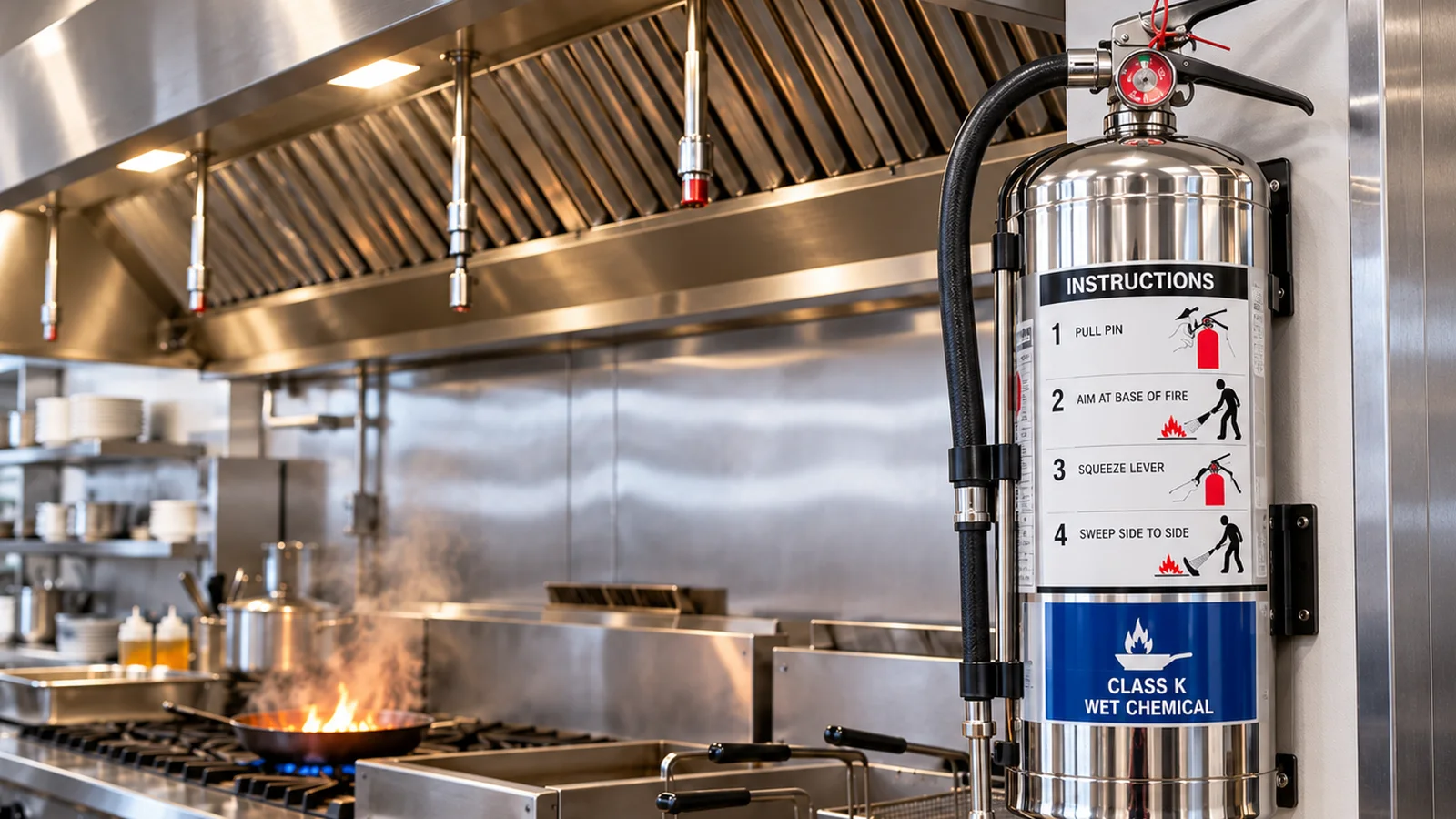
Where cooking appliances use vegetable or animal oils, NFPA 10 requires a Class K extinguisher. That covers fryers, griddles, ranges, broilers, and woks — anything producing hot cooking media. It is not conditional on having a deep fryer.
The agent is wet chemical, and it works differently from anything else in the building. On contact with hot oil it saponifies: the chemical reacts with the fat to form a soapy foam layer that seals the surface, cuts off oxygen, and cools the oil below its auto-ignition point. That last part matters, because cooking oil at temperature will reignite on its own the moment the blanket is disturbed.
The travel distance rule is also tighter here. For most hazards in a building, the general travel-distance limits apply. For Class K hazards, the maximum travel distance from the hazard to the extinguisher is thirty feet. On a long cooking line that frequently means more than one unit, which is the requirement most often missed in kitchens that have "a Class K extinguisher" — singular, by the back door.
Mount it where a cook would actually reach it while backing away from the appliance, not on the far wall past the hazard.
A Kitchen Needs More Than Its Class K Unit
The Class K extinguisher addresses cooking media. It does nothing for the rest of the premises, and a kitchen is not exempt from the general extinguisher requirement because it has one.
The dining room, prep areas, dry storage, and back-of-house corridors are Class A hazards and need Class A coverage. Any area with solvents, cleaning chemicals, or fuel is a Class B hazard. Walk-in compressors, electrical panels, and equipment rooms bring Class C considerations. A restaurant that passes on the cooking line and has nothing in the storeroom has a deficiency in the storeroom.
This is where restaurants get caught by the simplest version of the problem: one wet chemical unit by the fryer, and a kitchen whose remaining three hundred square feet of prep and storage is uncovered. Which class belongs in which area is a general question, covered in our guide to choosing the right fire extinguisher class.
A practical note on substitution: you cannot run the kitchen on ABC dry chemical alone, and you should not try. Dry chemical does not saponify, discharging it at a grease fire can splash burning oil out of the vessel, and its residue is a problem in a space with a wet chemical hood system above it.
The Placard Next to the Class K Unit
NFPA 10 requires a placard near each Class K extinguisher instructing the user to actuate the fixed fire suppression system before using the portable extinguisher. It is a small sign, it is cheap, and it is missing in a large share of the kitchens we walk into.
The ordering it enforces is deliberate. The hood system is designed to discharge over the appliances and shut down the fuel or power to them. A portable discharged first can disturb the oil surface, and more importantly it can give staff the impression the fire is handled while the appliance is still at temperature and still receiving gas. The system goes first; the extinguisher handles what the system leaves.
Because the placard is tied to the extinguisher rather than to the hood, it falls to whoever services your portables to fit it — so it is worth asking for explicitly at your next service visit rather than assuming it arrived with the unit.
Where the Hood System Ends and the Portable Begins
These are two systems with two schedules and two service records, and neither one substitutes for the other.
The hood suppression system is a fixed system over the appliances, inspected semiannually by a qualified contractor, with nozzle placement matched to the appliances underneath it. The grease accumulation, nozzle caps, cleaning records, and failure modes on that side are covered in our guide to the hidden fire risks in a commercial kitchen.
The portable extinguishers are yours to inspect monthly and have serviced annually. One point specific to kitchens: wet chemical units run on a shorter hydrostatic cycle than the dry chemical units elsewhere in the building, so a Class K extinguisher reaches its internal milestones sooner than the ABC unit in the corridor. Whether a given unit gets refilled or retired at that point is covered in our guide to when an extinguisher is condemned versus recharged.
Kitchens are also hard on equipment. Grease film on a cylinder, a crusted nozzle, or a label gone unreadable from heat and cleaning chemicals are all findings, and all more likely here than anywhere else in the building.
What a Restaurant Has to Be Able to Produce
When an inspection happens, the physical check takes a few minutes and the paperwork takes longer. A restaurant should be able to put hands on:
- Current service tags on every portable extinguisher, including each Class K unit.
- Monthly inspection records for the portables, with the month, year, and initials of whoever performed each check.
- Hood suppression service reports from the most recent semiannual visit.
- Hood and duct cleaning records at the frequency your cooking volume requires.
The pattern we see is a restaurant that is substantively compliant and cannot prove it, because the tags are current but nobody kept the monthly records, or the binder is at the owner's other location. Keep all four in one place on the premises.
If something does get written up, the route back is documentation-led rather than equipment-led, which is the same across every system in a commercial building — our FDNY compliance resources cover how a finding becomes a violation and what closes it.
Frequently Asked Questions (FAQ)
Do I need a Class K extinguisher if I have a griddle but no deep fryer?
Yes. The requirement is tied to cooking appliances using vegetable or animal oils, not specifically to fryers. A griddle, range, broiler, or wok station producing hot cooking media creates a Class K hazard, and a unit rated for it has to be within reach of that hazard.
How far can my Class K extinguisher be from the cooking line?
The maximum travel distance from the Class K hazard to the extinguisher is thirty feet, which is shorter than the general limits elsewhere in a building. On a long line or an L-shaped kitchen, measuring the actual walking path rather than the straight-line distance usually shows that one unit is not enough.
Can I keep ABC extinguishers in the kitchen instead of a Class K unit?
No. ABC dry chemical is not rated for cooking media, does not form the sealing layer that prevents reignition, and risks splashing burning oil. You can have ABC units in the kitchen for the Class A and B hazards around the cooking line, but they do not satisfy the Class K requirement.
How often does a Class K extinguisher need to be serviced?
It follows the same rhythm as every other portable: a monthly visual inspection you perform in-house, and annual maintenance by a licensed company that tags it. The difference is on the longer cycle, where wet chemical units reach their internal examination and hydrostatic test sooner than dry chemical units do.
County Fire Inc. has equipped and serviced restaurant kitchens across the five boroughs since 2015, including the Class K units, the placards, and the Class A and B coverage behind the line. Call (888) 470-3473 or see our extinguisher inspection service to have your kitchen walked and the records brought up to date.