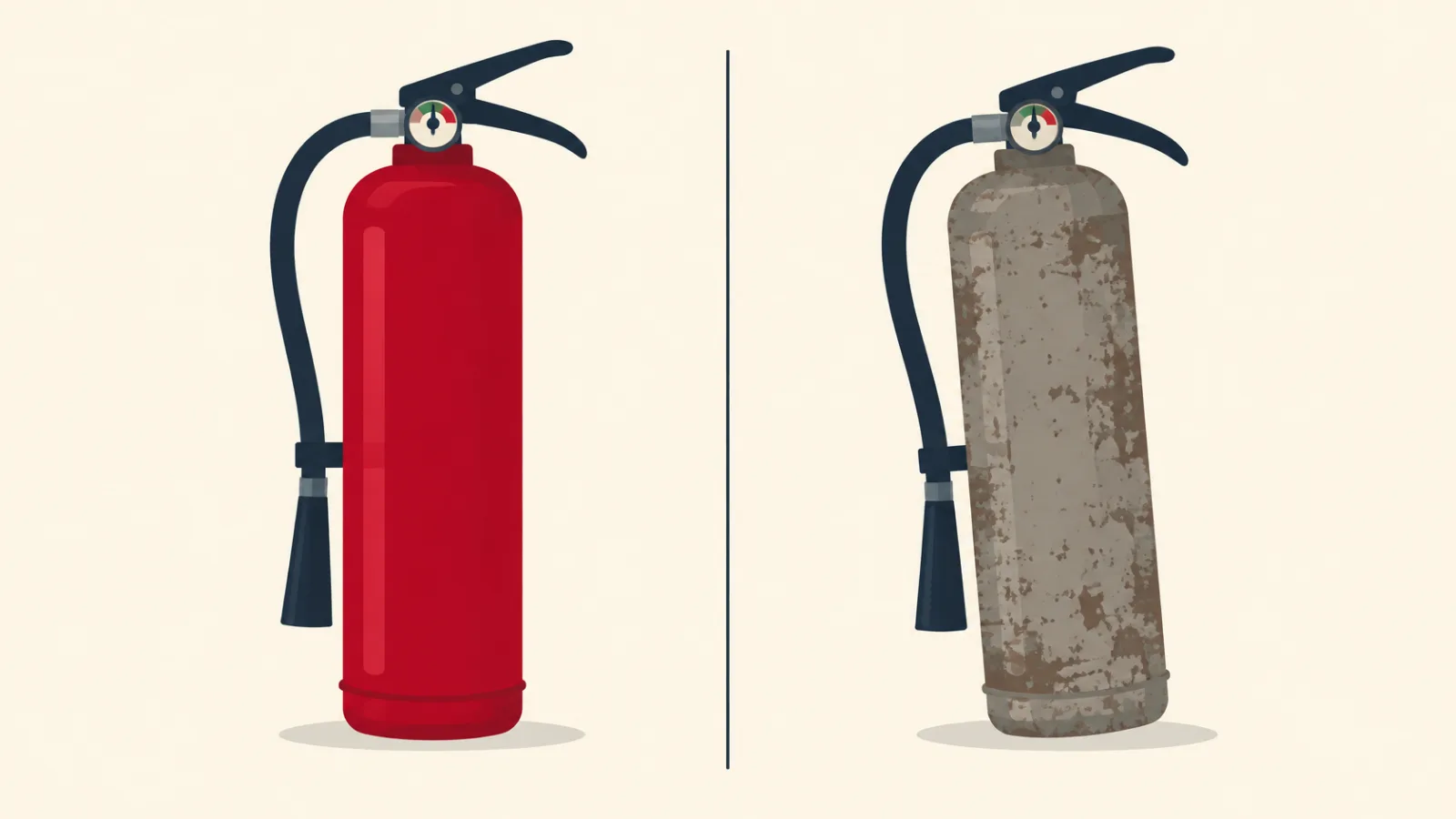
Monthly Fire Extinguisher Inspections: What Your Staff Can Do and What Needs a Licensed Company
Most property managers know their extinguishers get serviced once a year by an outside company. Far fewer know that the annual visit is only one of two recurring obligations, and that the other one belongs to the building — not the vendor.
The monthly inspection is the requirement that gets quietly skipped, because nobody in the building was ever told it was theirs to do. It takes a few minutes per unit, it needs no license, and the absence of a record for it is one of the easier deficiencies for an inspector to establish.
Inspection and Maintenance Are Two Different Words
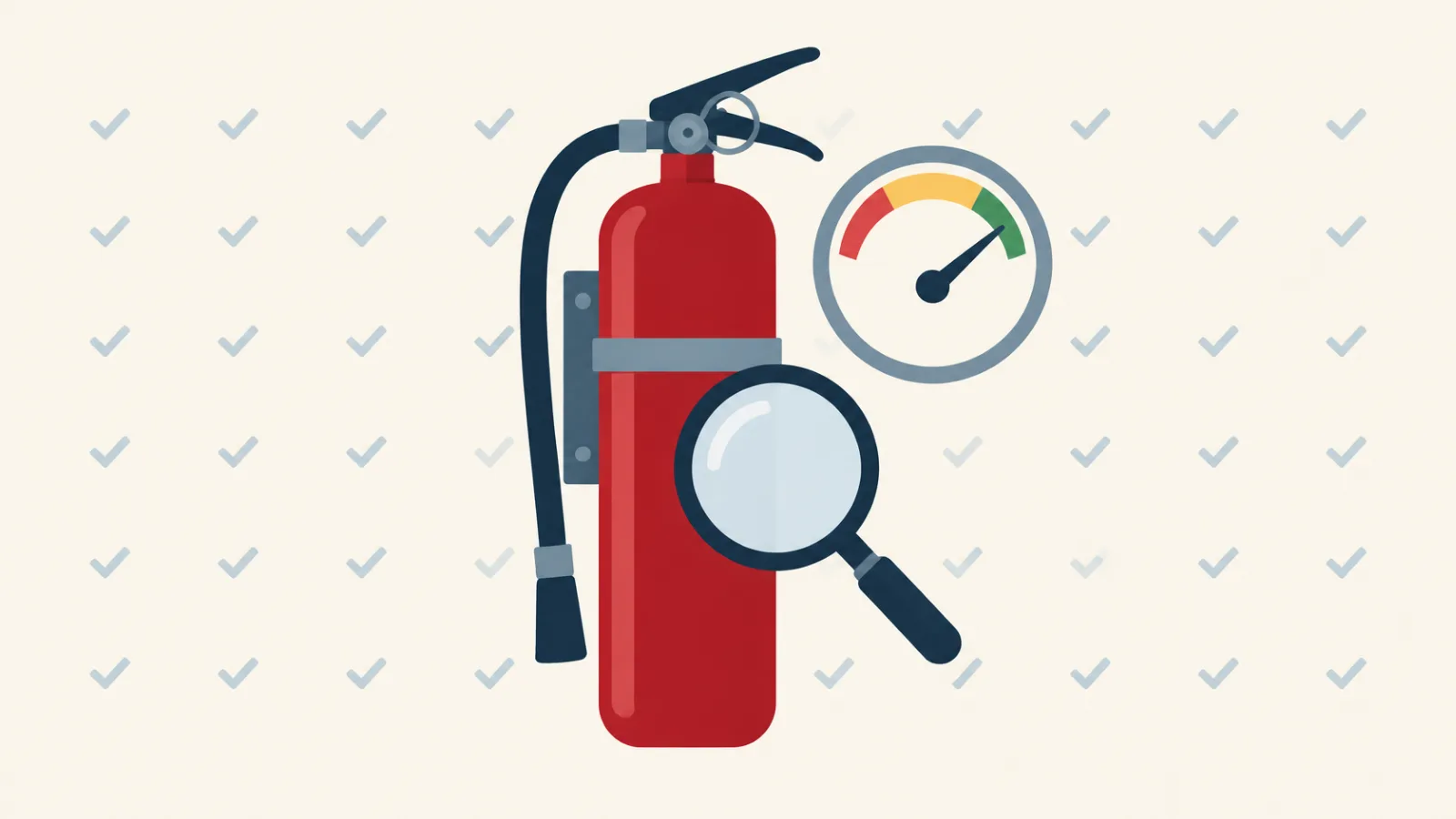
NFPA 10 uses both words precisely, and almost everyone in building management uses them interchangeably. That is where the confusion starts.
An inspection is the quick visual check confirming an extinguisher is present, accessible, and appears ready to operate. It happens monthly.
Maintenance is the thorough annual examination of the unit, its mechanical parts, and its agent, performed by a qualified person who then tags the extinguisher. When a property manager says "the annual inspection," this is what they mean.
Two further events sit on longer cycles: the internal examination, and the hydrostatic test of the cylinder itself. Those intervals and the question of when a unit is retired rather than refilled are covered in our guide to when an extinguisher is condemned versus recharged.
The distinction is not pedantry. The monthly inspection and the annual maintenance have different obligations, different qualified persons, and different records — and only one of them is something your vendor does for you.
What the Monthly Inspection Actually Checks
The monthly inspection is a defined list, not a glance down the corridor. For each unit:
- It is in its designated location, not moved to a different wall or set on the floor.
- Nothing obstructs access or visibility — no stacked boxes, no coat rack, no equipment parked in front of it, and the location signage is visible from the approach.
- The operating instructions on the nameplate are legible and facing outward.
- The safety seal and tamper indicator are intact and unbroken.
- The unit is full, determined by weighing or by hefting it.
- There is no obvious physical damage, corrosion, leaking, or clogged nozzle.
- The pressure gauge needle sits in the operable range rather than in a recharge or overcharge zone.
Two of these account for most real findings. Obstruction is the single most common, because corridors and back-of-house areas accumulate storage over a few weeks. The second is the gauge, which drifts slowly enough that nobody notices until someone looks on purpose.
If a unit fails any item, it comes off the wall and a licensed company services it. In the meantime the area still needs coverage, which usually means a replacement unit rather than an empty bracket.
Who Is Allowed to Do It, and Who Is Not
The monthly inspection may be performed by the owner or the owner's designated representative. In practice that is building staff: a superintendent, a porter, a facilities coordinator. No certification is required to perform or record it, which is precisely why it is a reasonable in-house task.
Annual maintenance is different. It requires a trained and certified person, and in New York City a company servicing portable fire extinguishers must hold the applicable FDNY company certificate. It documents that service by affixing approved proof of compliance to the unit — the tag an inspector reads first.
The line between the two is worth stating plainly for whoever you assign this to. Building staff look, heft, and write it down. Staff do not open a unit, discharge and refill it, replace a gauge or valve, or write on the service tag. Breaking a tamper seal takes the extinguisher out of service until a licensed company restores it, so a well-meant attempt to "check inside" creates a deficiency rather than clearing one.
If you are also unsure whether the units on the wall are the right type for the hazards around them, that is a separate question from either inspection — see our guide to choosing the right extinguisher class.
Recording It So It Counts
An undocumented inspection is indistinguishable from one that never happened, and this is where most buildings that are doing the walk-through still fail.
NFPA 10 accepts the record in more than one form: a tag or label attached to the extinguisher, a paper checklist kept on file, or an electronic record. What the record has to show is the month and year of the inspection and the identity or initials of the person who performed it. Where a listed electronic monitoring system is installed, that monitoring can stand in place of the manual monthly check.
Pick one method and use it consistently across the whole portfolio. The failure mode is a building where some units have punched tags, some are in a binder nobody has opened since the spring, and nothing reconciles. An inspector asking for twelve months of records is checking for continuity, so a gap of three months reads worse than a tidy record of a deficiency that was found and fixed.
Keep the monthly records with the annual service reports rather than separately. When an inspection goes wrong, the paperwork is what decides whether a finding becomes a violation — which is the same pattern across every system in the building, as our FDNY compliance resources set out.
Frequently Asked Questions (FAQ)
Can my building superintendent perform the monthly extinguisher inspection?
Yes. NFPA 10 allows the owner or the owner's designated representative to perform the monthly inspection, and no license or certificate is needed for it. What your superintendent cannot do is the annual maintenance, any internal work on the unit, or signing the service tag — those require a company holding the applicable FDNY certificate.
Does the monthly inspection have to be written down?
Yes, and this is the step most buildings miss. The record can be a tag on the extinguisher, a checklist on file, or an electronic record, but it has to capture the month, the year, and who performed the check. Doing the walk-through and recording nothing leaves you with no way to demonstrate compliance.
What is the difference between the monthly and annual extinguisher inspection?
The monthly check is a visual confirmation that the unit is present, accessible, undamaged, and showing correct pressure, and your own staff may do it. The annual service is a thorough examination of the unit and its agent by a certified technician, who tags it on completion. Both are required; neither substitutes for the other.
What should staff do if an extinguisher fails the monthly check?
Take it out of service and arrange for a licensed company to repair, recharge, or replace it, and keep the area covered in the meantime. Record what was found and what was done about it. A documented deficiency that was corrected is a far better position than a silent one.
County Fire Inc. has handled extinguisher service across the five boroughs since 2015, and we will set up the monthly checklist your staff runs alongside the annual service we perform, so the two records line up. Call (888) 470-3473 or see our extinguisher inspection service to get both halves of the obligation on one schedule.