Choosing and Sizing Fire Extinguishers for a NYC Commercial Space
Many fire extinguisher deficiencies in NYC commercial spaces begin with specification or placement rather than equipment failure: the wrong extinguisher for the hazard, too little coverage for the floor area, or a unit too far from the point where it would be needed. Equipment that is fully charged and properly tagged can still be improperly placed.
Getting this right is a layout exercise before it is a purchasing one. New York City Fire Code Section 906 governs portable fire extinguishers and applies NFPA 10, and both are written around three questions: what is burning, how far someone has to travel, and how much floor area one unit is allowed to cover.
Start With the Hazard, Then the Rating
Every extinguisher carries a rating that tells you what it fights and how much of it. The letter identifies the fire class — ordinary combustibles, flammable liquids, energized electrical equipment, combustible metals, or cooking oils and fats. The number in front of the letter is a capacity figure, not a size in pounds.
For a commercial space, start by walking the floor and naming the actual hazard in each area. An office floor, a corridor, and a records room are ordinary combustible hazards. A paint locker, a generator room, or a parking level introduces flammable liquids. A commercial kitchen with a fryer is a cooking-media hazard and is treated separately from everything around it. A single space frequently holds more than one.
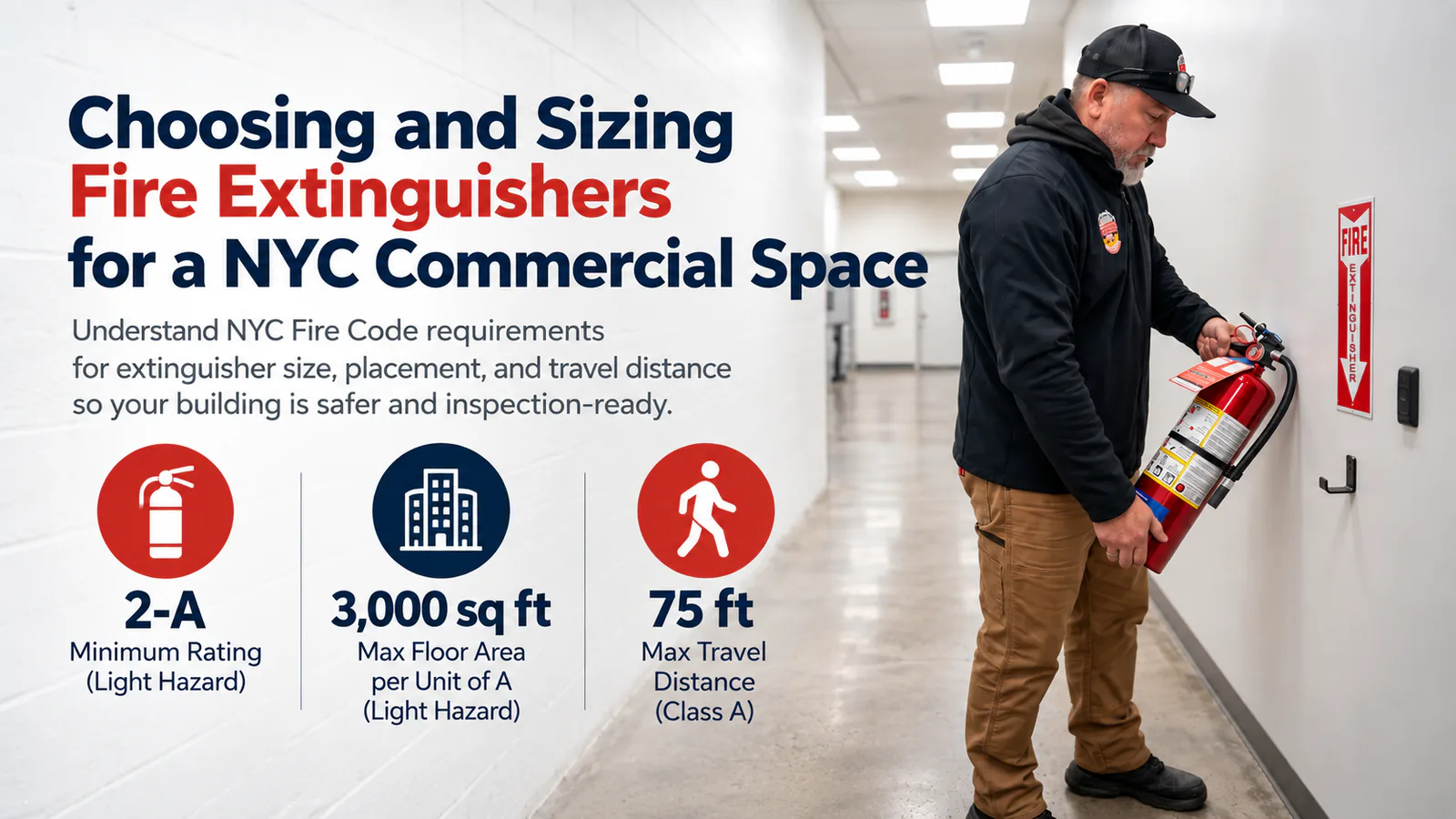
Fire Code Section 906 sorts Class A occupancies into light, ordinary, and extra hazard, and that classification drives the minimum rating you are allowed to install. Light and ordinary hazard areas require at least a 2-A rated extinguisher. Extra hazard areas require at least 4-A. For energized electrical equipment, selection must also address the Class C hazard. Fire Code Section 906.3.3 directs the size, number, and placement of extinguishers for Class C hazards to NFPA 10.
Buying a larger unit than the minimum is allowed and is often sensible. Buying a smaller one to save money is a deficiency waiting to be written up.
Floor Area Decides How Much Rating You Need
Once the hazard classification is set, the code converts it into coverage. Each unit of A rating is credited with a maximum floor area, and that area shrinks as the hazard rises.
These are the Class A requirements set out in New York City Fire Code Table 906.3.1.
| Hazard classification | Minimum extinguisher rating | Max floor area per unit of A | Max Class A travel distance |
|---|---|---|---|
| Light | 2-A | 3,000 sq ft | 75 ft |
| Ordinary | 2-A | 1,500 sq ft | 75 ft |
| Extra | 4-A | 1,000 sq ft | 75 ft |
The table establishes minimum Class A rating and coverage. The actual number and placement of extinguishers may still be driven by travel distance and the building layout.
That distinction is where the arithmetic is most often misread. A 6,000 square foot light hazard area divided by 3,000 square feet per unit of A calls for two units of A rating — and a single 2-A extinguisher already represents two units of A. The calculation establishes the minimum rating required. It does not by itself establish the final number of extinguishers.
Rating arithmetic determines minimum capacity; travel distance and layout often determine the actual number of extinguishers. Partitions, doors, corridors, the real path of travel, and the ceiling on how much floor area any single unit may cover can each require more extinguishers than the rating alone suggests.
This is the calculation most often skipped when a building simply replaces what was on the wall before. If the space has been subdivided or taken on storage, the old quantity is evidence of nothing.
Travel Distance Often Determines the Actual Extinguisher Count
Coverage math gives you a minimum rating. Travel distance tells you where the units go, and it is frequently what sets the final count.
For Class A hazards, the maximum travel distance to an extinguisher is 75 feet. That is walking distance along the path a person would really take — around partitions, through door openings, down the corridor — not a straight line drawn on a floor plan. A point that appears close to an extinguisher on a floor plan can exceed the permitted travel distance once walls, corridors, doors, and the actual path of travel are considered.
Flammable liquid hazards tighten considerably, to 30 or 50 feet depending on the extinguisher's rating and the hazard involved. Cooking equipment tightens further: an extinguisher for commercial cooking equipment must be within 30 feet of that equipment. Combustible metal hazards have their own placement rules under NFPA 10.
Two practical consequences follow. First, travel distance frequently forces more extinguishers than the floor area calculation does, particularly in long, narrow, or heavily partitioned NYC floor plates. Second, any renovation that moves a wall can break compliance without anyone touching the equipment. A tenant fit-out that adds a corridor is a reason to re-walk the extinguisher layout, and it is worth folding into the same visit as your annual extinguisher inspection.
Mounting, Clearance, and Being Findable
Placement is not finished when the unit is in the right zone. It has to be mounted so a person under stress can see it, reach it, and lift it.
NFPA 10 sets the heights by weight. An extinguisher with a gross weight of 40 pounds or less is installed with its top no more than 5 feet above the floor. Anything heavier than 40 pounds, other than a wheeled unit, has its top no more than 3.5 feet above the floor. In both cases the bottom of the extinguisher must sit at least 4 inches above the floor.
Beyond height, the unit has to be conspicuous and unobstructed. The common failures in occupied NYC buildings are mundane and repeat everywhere: cartons stacked in front of the cabinet, a coat rack in the corridor, a unit moved behind a new reception desk, or signage removed during a repaint. An extinguisher resting loose on the floor because its bracket broke is a deficiency even when the equipment itself is in perfect condition.
Mount to the manufacturer's listed hanger or bracket for that specific model. Brackets are part of the listing, not a generic accessory.
Who May Supply and Service Them in New York City
New York City regulates the servicing side, not just the equipment. A company servicing portable fire extinguishers must hold the applicable FDNY company certificate, and it documents that servicing by affixing the approved proof of compliance to the unit. The tag on the extinguisher is the record an inspector reads first, which is why the vendor's credentials matter as much as the hardware.
That also shapes the buy-versus-recharge question at the point of purchase. Rechargeable extinguishers can be serviced, hydrostatically tested, and kept in service for a long working life. Non-rechargeable units cannot be brought back once discharged and have a fixed service life under NFPA 10. For a commercial space with a real inspection obligation, rechargeable units are usually the correct specification.
When you are equipping a new space, a renovated floor, or a building whose count has drifted, the sequence is: classify each hazard area, calculate the required rating from floor area, overlay the travel distance limits, then pick mounting locations that satisfy both and stay visible. County Fire's extinguisher sales and installation service covers that survey and specification along with supply, mounting, and initial tagging, so the layout is documented rather than inherited.
Frequently Asked Questions (FAQ)
How many fire extinguishers does my NYC commercial space need?
There is no single number, because two separate rules apply and you follow whichever demands more units. Floor area sets the required rating — one unit of A rating per 3,000 square feet in a light hazard area, 1,500 in an ordinary hazard area, and 1,000 in an extra hazard area. Travel distance then sets placement, and in partitioned NYC floor plates it usually drives the count higher than the area calculation alone.
How far can someone be from a fire extinguisher?
For ordinary combustible hazards, the maximum travel distance is 75 feet. Flammable liquid hazards reduce that to 30 or 50 feet depending on the rating and hazard, and an extinguisher serving commercial cooking equipment must be within 30 feet of it. Travel distance is measured along the actual walking path, not as a straight line across the floor plan.
How high should a fire extinguisher be mounted?
Under NFPA 10, an extinguisher with a gross weight of 40 pounds or less has its top no more than 5 feet above the floor, and one heavier than 40 pounds has its top no more than 3.5 feet above the floor. The bottom of any unit must be at least 4 inches above the floor. Use the listed bracket for that model rather than a generic hanger.
Do I need a different extinguisher for my commercial kitchen?
Yes. Cooking oils and fats are a distinct fire class and require an extinguisher rated for cooking media, placed within 30 feet of the cooking equipment. That unit is in addition to the extinguishers protecting the ordinary combustible hazards in the rest of the space, and it does not replace the fixed suppression system over the appliances.
Can I just buy a fire extinguisher and install it myself?
Buying and mounting the hardware is only one part of compliance. The extinguisher has to be appropriate for the hazard in that area, and its rating and placement have to satisfy the applicable requirements. The required inspection and servicing must be performed by appropriately qualified providers, and where FDNY proof-of-compliance tagging applies, that has to be satisfied as well. The compliance problem is an installation nobody has specified, verified, or serviced — not who physically mounted the bracket.
Does a tenant renovation change my extinguisher requirements?
Frequently, yes. New partitions lengthen travel paths, a change of use can move an area from light to ordinary or extra hazard, and added storage raises the fuel load. Any of those can require more units or higher ratings even though the existing extinguishers are perfectly serviceable. Re-walk the layout when the space changes rather than waiting for an inspection to find it.
County Fire Inc. has supplied, sized, and installed portable fire extinguishers across all five NYC boroughs since 2015. If you are fitting out a new space or you cannot say why your building has the number of extinguishers it has, call (888) 470-3473 and start with a floor survey rather than a parts list. Our extinguisher sales and installation team will document the hazard classification, count, and placement behind every unit it mounts.