Most FDNY violations are not ignored on purpose. The notice arrives during a month with three other problems in it, the condition does not look urgent, and the correction period is long enough that the matter drops down the list. Then it stops being a repair and starts being a record.
Here is what actually happens in the interval, in the order it tends to happen.
The Deadline Moves Before You Do
Every FDNY finding carries a correction period, and it runs from issuance rather than from the day the paperwork reaches whoever handles compliance for the building. Where mail passes through a managing agent before it reaches an owner, a meaningful share of the window is gone before anyone has read the document.
That matters because the deadline is not a soft target. It is the point at which the department's posture changes from expecting a correction to treating the condition as uncorrected. A finding that would have closed quietly with a repair and a certification becomes one with a history attached, and the history is what follows the property.
Nothing dramatic marks the moment. That is precisely the difficulty — the cost of missing a deadline is invisible on the day it passes and obvious months later.
Penalties Escalate on Repetition, Not Just Delay
The FDNY publishes a penalty schedule that sets amounts by violation category, and the structure is worth understanding because it is where the cost curve steepens.
Take VC 12, Fire Protection Systems, the category most commonly at issue when a commercial building's alarm or sprinkler system is cited. A first violation carries a penalty of $950, reduced to $475 if mitigated, with a maximum of $1,000. A second or subsequent violation carries $2,250, mitigated to $1,125, with a maximum of $5,000. Source: NYC FDNY Summons Penalty Schedule, 3 RCNY §109-03.
The pattern repeats across categories at different amounts. VC 1, Portable Fire Extinguishers and Fire Hoses, starts at $600 and rises to $1,500 on a second offence. VC 9, Rooftop Access and Means of Egress, starts at $950.
The important detail is that repetition is what multiplies the figure. A building that leaves a condition unresolved is not simply exposed to the original penalty for longer — it is exposed to the possibility of being cited again for the same category at the higher rate, and buildings with open findings tend to attract closer attention rather than less.
An Open Violation Is a Disclosure Problem
The penalty is usually not the largest cost. The larger one is that an open violation is a matter of record, and records surface at inconvenient moments.
Refinancing, sale, and insurance renewal all involve someone examining the property's compliance history. An open FDNY finding raises questions that a closed one does not, and it raises them at the point of a transaction rather than at the point where fixing it would have been routine. Deals do not usually collapse over a fire safety violation. They slow down, and the slowdown has a price.
Conditions that leave a building's detection, notification, or suppression impaired can also lead to orders restricting how the premises may be occupied or used until the condition is corrected. For a commercial building with tenants, that is not an administrative inconvenience.
Insurance Is the Exposure Owners Underestimate
Commercial property policies generally assume the fire protection systems described in the application are present and functioning. Where a loss occurs and the maintenance record shows they were not, coverage can be reduced or denied.
An open FDNY violation is documentary evidence, produced by a public agency, that a condition existed and was known. It is difficult to characterise a system as adequately maintained while a finding to the contrary sits unresolved against the building. Insurers examine inspection history after a loss as a matter of routine, and gaps in that history are exactly what they look for.
This is the asymmetry that makes deferral a poor trade. The penalty is bounded and knowable. The insurance exposure is neither.
Clearing Gets Harder, Not Easier
There is a practical reason to act early that has nothing to do with penalties.
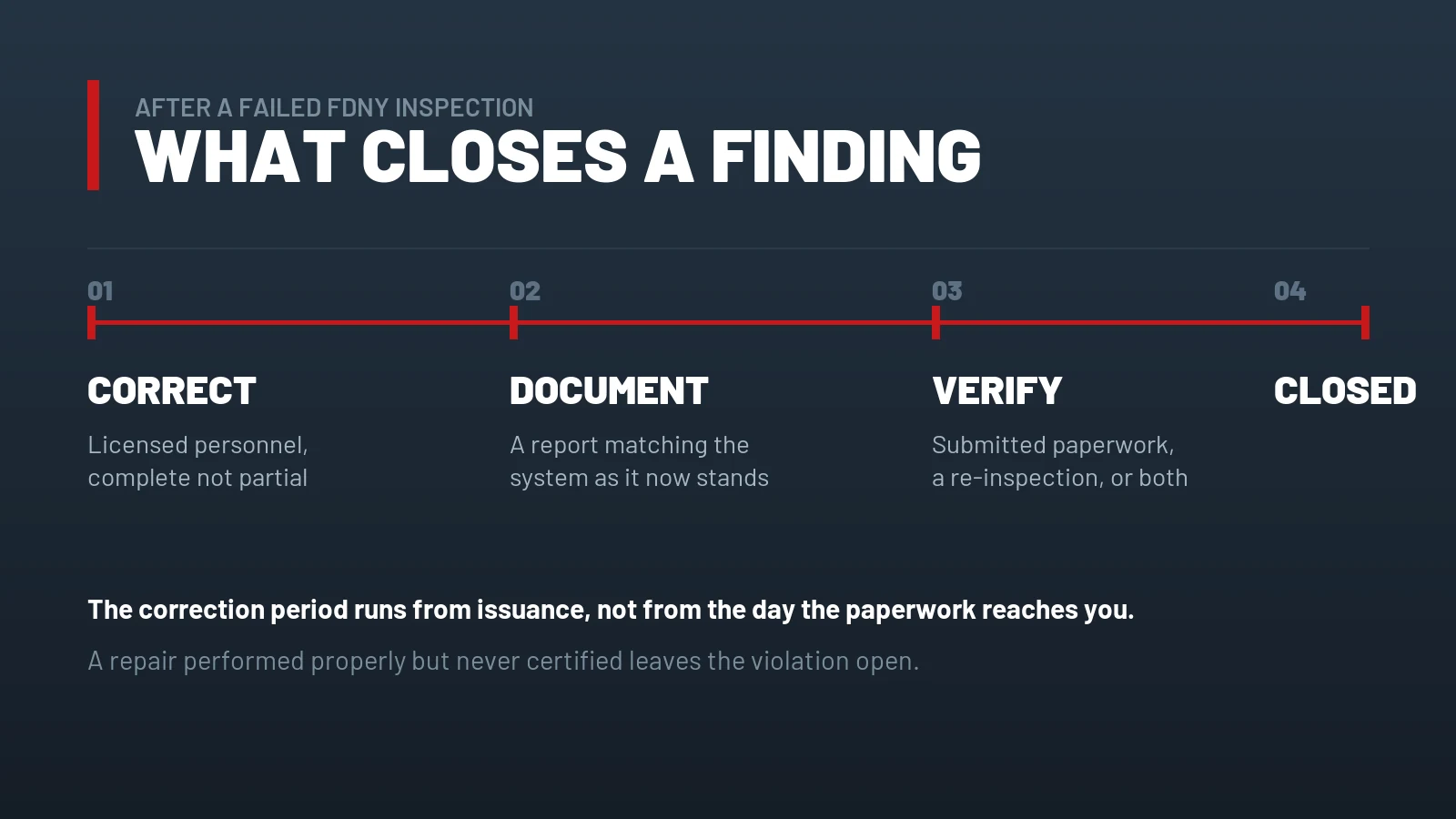
Clearing a finding requires the correction to be performed by appropriately licensed personnel, documented in a form the department accepts, and in many cases verified through submitted paperwork or a re-inspection. All of that depends on records, and records decay. Vendors change. The technician who serviced the system leaves. The report that would have demonstrated the system's condition at the time of the citation becomes harder to obtain with every month that passes.
A finding addressed within its correction period is usually a scheduling problem. The same finding addressed a year later is an archaeology problem first and a scheduling problem second. Depending on the system cited, the path runs through fire alarm violation removal, sprinkler violation removal, or extinguisher violation removal.
Frequently Asked Questions (FAQ)
How much does an FDNY violation cost if I do nothing?
The penalty depends on the violation category and on whether it is a first or repeat offence. Fire Protection Systems findings begin at $950 and rise to $2,250 for a second or subsequent violation, with a maximum of $5,000. The penalty is rarely the largest cost, though — an unresolved finding also affects financing, sale, and insurance renewal.
Can an unresolved FDNY violation affect my insurance?
It can. Commercial policies generally assume fire protection systems are present and maintained, and an open violation is agency-produced evidence that a condition existed and was known. Insurers review inspection and maintenance history after a loss, and an unresolved finding is difficult to reconcile with a claim that the system was properly maintained.
Is it too late to clear an old FDNY violation?
No, but it is harder. Clearing requires documentation produced by licensed personnel and, in many cases, verification by the department. The obstacle with older findings is usually evidentiary rather than technical — vendors change and records go missing, so reconstructing what was done and when takes longer than the repair itself.
County Fire Inc. has cleared FDNY findings for NYC building owners since 2015, including ones that sat open considerably longer than their correction period. Clearing them draws on the full range of fire protection services. If something is outstanding against your building, call (888) 470-3473 or start with our FDNY compliance overview.