FDNY Violation Lookup: How to Check Violations on Your Building
Maybe a notice was taped to the lobby door. Maybe a buyer's attorney asked whether the building has any open FDNY violations, and nobody in the office knows. Or maybe you just took over a portfolio and want to know what the last manager left behind. Whatever brought you here, the question is the same: what does the Fire Department actually have on file for this building?
The good news is that you can find out. The less obvious news is that there is no single search box that shows you everything. FDNY records live in a few different places, and each one answers a slightly different question. This guide walks through all three, in the order most owners should try them.
Start With the Paper You Have
If someone handed you a notice, that piece of paper is your fastest route to an answer. Every FDNY Violation Order and summons carries a record number, and that number is the key to the online lookup.
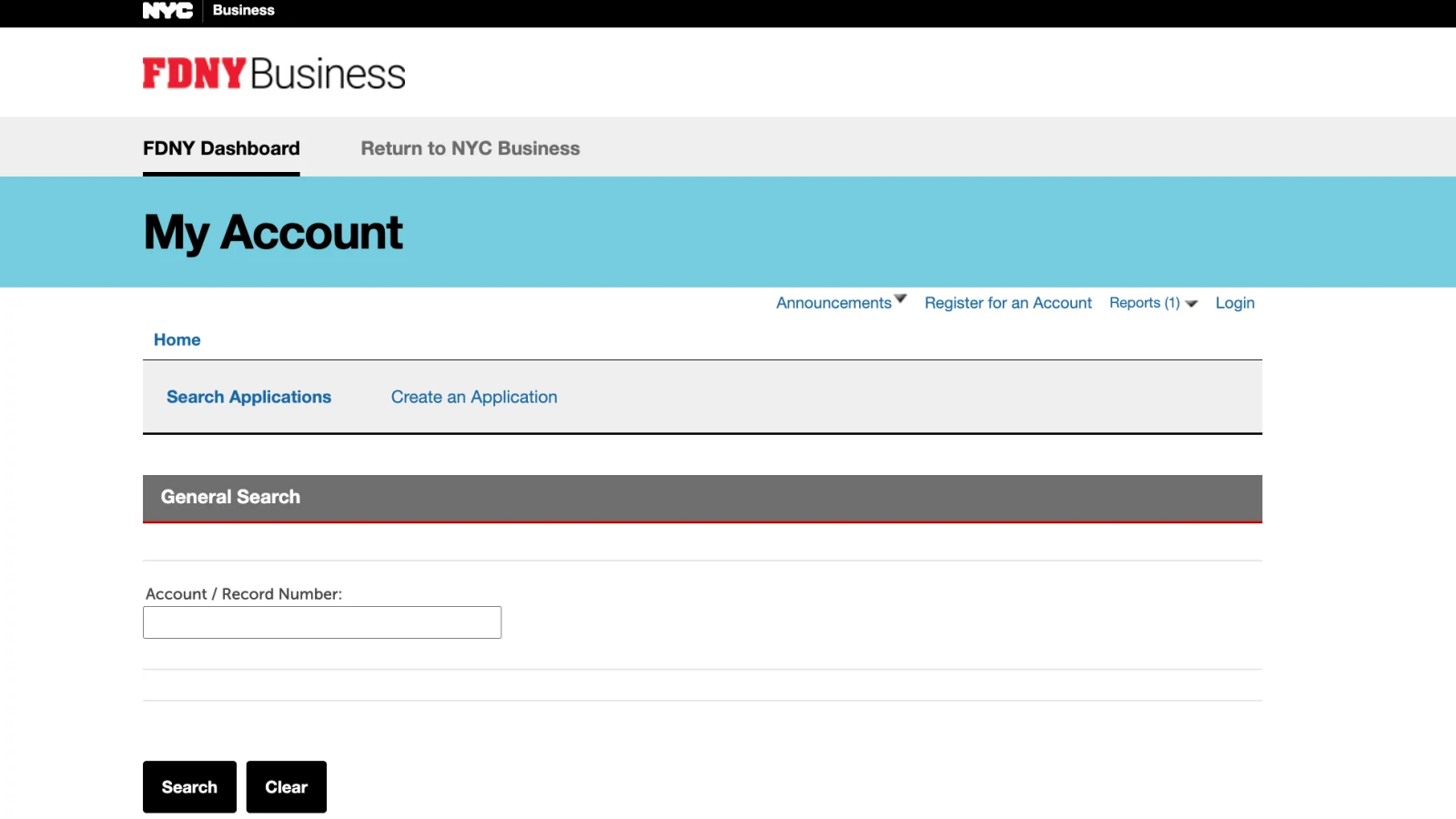
FDNY Business, the department's online portal, lets anyone check the status of a violation or summons without logging in. From the FDNY Business home page, choose Search Applications/Requests, or pick Violation Search from the services menu. Enter the account or record number from the notice and press search. The portal returns the record, the property address, and its current status, so you can see at a glance whether it is still open, resolved, or dismissed.
Two things trip people up here. First, the anonymous search is a record-number search, not an address search. You cannot type in a street address and see every violation on the building. Second, the view is read-only. You can see the status, but you cannot open or upload documents without an account.
If the search returns nothing and you are sure the number is right, FDNY Business Support can help. Call 311 and ask for FDNY Business Support, or email FDNY.BusinessSupport@FDNY.nyc.gov.
Not sure what the notice in your hand actually means? Call County Fire at (888) 470-3473 and read us the record number. We will tell you what kind of notice it is and what it takes to close it.
Check OATH for Summonses and Hearing Dates
A Violation Order and a summons are not the same thing, and the difference decides where you look next. As we explain in our guide to FDNY violation codes, a Violation Order directs you to correct a condition within a set period. A summons, by contrast, goes to a hearing at the Office of Administrative Trials and Hearings, better known as OATH. That is where penalties are decided.
OATH runs its own search tool, the Summons Finder, which lets you look up a summons by name, address, or summons number. Unlike the FDNY Business anonymous search, this one works with an address. It shows you a copy of the summons and the scheduled hearing date. For a wider view, OATH also publishes its Hearings Division case status records on NYC Open Data, including the charge, the issuing agency, the outcome, and any penalty imposed.
The hearing date is the number to circle. FDNY guidance is blunt about it: do not assume that correcting the condition automatically cancels your hearing. Unless FDNY or OATH confirms you are excused, you are expected to attend.
If a summons search fails, OATH suggests re-entering the number with a space after every third digit. You can also reach the OATH Clerk's Office at 844-628-4692.
Request the Full List for an Address
Here is the gap most owners discover the hard way. If you do not have a record number, and the problem is not a summons, there is no free online search that lists every open FDNY Violation Order on a property.
For that, FDNY's Public Records Unit offers the Summonses and Violation Orders Special Report. It is a list of all open summonses and Violation Orders associated with a property, and the fee is $10. You fill in the property address and borough, then submit the form in person at FDNY headquarters at 9 MetroTech Center in Brooklyn, or by mail with a check or money order made out to "NYC Fire Department" and a stamped, self-addressed envelope. Because payment has to be included, the request cannot be sent by email. Cash is not accepted.
This is the report worth ordering in three situations:
- Before you buy or refinance. Open fire violations travel with the building, not the seller.
- When you take over management. You inherit the previous manager's unfinished business.
- When you suspect something was missed. Notices go missing, get handed to the wrong tenant, or sit in a super's drawer.
A $10 report that turns up nothing is cheap peace of mind. One that turns up an old Violation Order is far cheaper than finding it at closing.
You Found an Open Violation. Now What?
Finding the record is step one. Closing it is the part that matters, and the clock is usually already running.
Start by working out what you are dealing with. A Violation Order sets a correction period. A summons sets a compliance date for your Certificate of Correction and a hearing date. Write both down. The correction period does not pause while you figure out who to call.
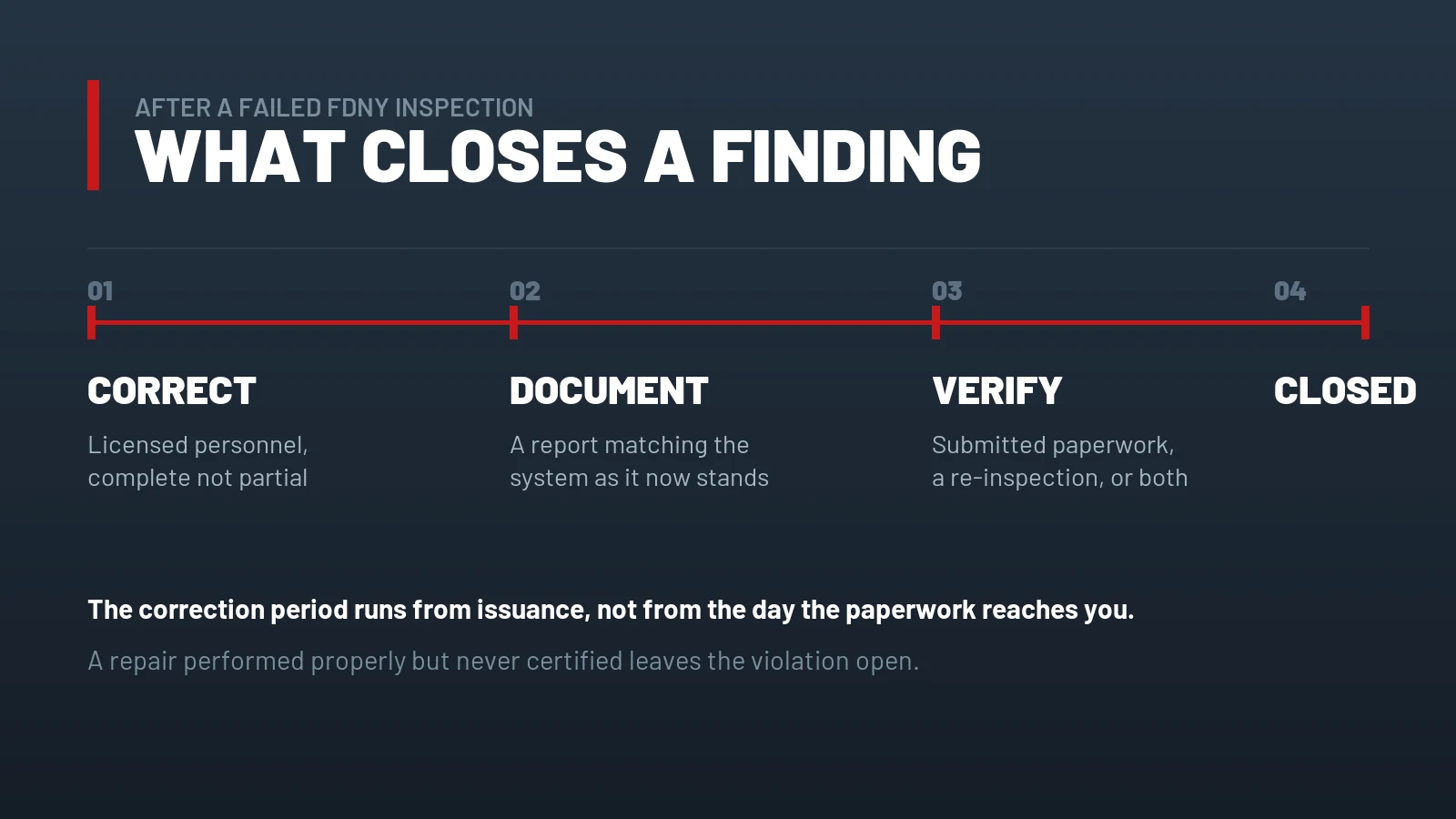
Then fix the actual condition. That sounds obvious, but a surprising number of violations come back because the paperwork was filed before the work was done properly. If the cited problem is a fire alarm device, a sprinkler head, or an extinguisher, the correction has to be made by a qualified company and documented in a way FDNY accepts.
Finally, prove it. For a summons, FDNY requires a Certificate of Correction with supporting documentation, submitted online through FDNY Business by the compliance date on the summons. Email submissions are not accepted. Repeat offenders may still need to attend the OATH hearing even after the correction is approved.
That last stretch, from "fixed" to "officially closed," is where most of the stress lives. It is also exactly what our FDNY compliance team handles every week across all five boroughs. If the violation involves your alarm system specifically, our fire alarm violation removal service covers the correction, the documentation, and the re-inspection closeout.
Have an open violation and a deadline? Ask for a free violation quote. We respond within 24 hours with next steps, before the correction period gets any shorter.
Frequently Asked Questions (FAQ)
Can I look up FDNY violations by address?
Partly. The free FDNY Business search needs the record number from the notice, so it will not list violations by address. OATH's Summons Finder does search by address, but it only covers summonses. For a full list of open summonses and Violation Orders on a property, order the $10 Summonses and Violation Orders Special Report from FDNY's Public Records Unit.
Do I need an account to check an FDNY violation?
No, not for a basic status check. FDNY Business lets anyone view the status of a violation or summons without logging in, as long as you have the record number. You will need an NYC.ID account to log in when you want to upload documents or submit a Certificate of Correction.
Does fixing the violation cancel my OATH hearing?
Not automatically. FDNY advises owners to attend the hearing on the date shown on the summons unless FDNY or OATH has confirmed that you are excused. Submit your Certificate of Correction by the compliance date, then confirm your hearing status rather than assuming it.
What is the difference between a Violation Order and a summons?
A Violation Order describes the condition, the remedy, and a correction period, and it has no hearing attached. A summons is adjudicated at an OATH hearing, where penalties can be imposed and where you can contest the finding. Both need the underlying condition corrected.
How long does it take to clear an FDNY violation?
It depends on the condition and the paperwork. A single faulty device can often be corrected quickly, while a system-wide deficiency takes longer to repair and document. The deadline is set by the correction period or compliance date on your notice, so start the correction as soon as you find the record.
Finding an open FDNY violation is stressful, but it is a solvable problem with a clear finish line. County Fire has been correcting and closing FDNY violations for NYC buildings since 2015. Call (888) 470-3473 or visit our FDNY compliance page to get a free violation quote and a clear plan to close it out.